
Understanding Clark County Releases
A Clark County release means that the sheriff no longer holds the person in the same local custody event. It does not always mean the person walked into the community free of all legal control. A person may leave on a summons, personal recognizance, bond, time served, dismissal, or another court-authorized basis. The sheriff may instead transfer the person to the Missouri Department of Corrections, another county, a federal authority, or immigration custody. A transfer is a custody change, not a community release.
The Clark County Jail uses a live JailTracker list for current custody. A name will usually drop from that public list after release or transfer. The lasting proof is more likely to be the booking and release record, a weekly sheriff narrative, the court docket, or a record kept by the receiving agency. Charges listed at booking are allegations. They can differ from charges later filed or resolved in court.
Note: Match the sheriff event with the controlling court entry and any receiving-agency record before describing the outcome.
Clark County Release Types
The release code tells more than the fact that local confinement ended. Clark County weekly reports sometimes state the immediate mechanism, which can help separate a short booking event from a completed sentence. Keep the exact agency phrase when it is available.
- Summons
- The person is directed to appear later and may not have remained in a jail cell. It is not a finding on the charge.
- Personal recognizance
- A court-authorized release without a cash deposit, with a duty to return for later proceedings.
- Bond
- Release occurs under bond terms set in the case. The court record can show the related bond action.
- Time served or sentence completed
- The custodial part of a sentence ends. State supervision can still follow in some cases.
- Transfer
- Another named authority receives custody. This must not be labeled release to the community.
Parole and conditional release have a separate meaning in state prison cases. The person has left an institution but remains under MODOC authority. Final discharge ends the covered sentence or supervision and can make the person disappear from the active MODOC name search.
Clark County Release Record Fields
A release record is not one standard form. It may be a release screen in the jail system, a booking sheet with a release block, a recognizance form, a court order, or a line in a weekly report. A focused Clark County request should tie the beginning and end of one custody event together.
| Field | What it shows |
|---|---|
| Full name and aliases | Identifies the person while allowing for name variants. |
| Booking number | Ties the request to one arrest and jail event. |
| Admission date and time | Marks when local custody began. |
| Release date and time | Records when the sheriff ended that custody event. |
| Release disposition | States summons, recognizance, bond, time served, transfer, or another code. |
| Receiving agency | Names the next custodian when the event was a transfer. |
| Booking charges | Lists allegations recorded at intake, not a final court result. |
| Court or case number | Connects the jail event to the public court file. |
The Missouri sheriff retention schedule treats inmate files as broader than the public roster. SHF 013 includes intake and booking data, confinement reason, admission and release dates, property or cash receipts, and transfer information. The minimum retention is five years after release, with audit, litigation, or other controlling rules able to extend it. That period applies to the underlying file, not to how long a name or photo remains online.
Request Clark County Release Records
Send a narrow Sunshine request to the Clark County Sheriff's Office. Identify the person, approximate booking dates, and booking or case number if known. Ask only for the public parts needed to confirm admission, release, disposition, and any receiving agency. A booking photograph can be requested for the same numbered event, though Clark County publishes no dedicated photo form or guaranteed photo-access policy. This helps the custodian separate open material from protected content.
- Address the request to the custodian of records under Missouri Chapter 610.
- Describe one custody event with the name, date range, and known booking or case number.
- Request admission and release times, the release disposition, public bond fields, and the receiving agency if transferred.
- Ask for electronic delivery, reasonably segregable public portions, and the legal basis for anything withheld.
- Request a fee estimate before work begins if cost is a concern, and retain the response with the court record.
518 N. Lincoln St.
Kahoka, MO 63445
Phone: 660-727-2911
Fax: 660-727-2445
Email: clarksheriff@clarkmosheriff.com
Section 610.023 requires action as soon as possible and no later than the end of the third business day after receipt. More production time is allowed for reasonable cause if the custodian gives a detailed reason and the earliest time and date. That is a response deadline, not a promise that every record will be produced within three days.
Missouri Release Records Law
Missouri Chapter 610 supplies the public-record framework for a Clark County release request. Section 610.100 makes arrest and incident reports open within its terms and keeps the disposition portion accessible even when an arrest report later closes because no charge was filed within the stated period. A request for admission, release time, and release disposition has a firm legal basis, but that does not mean every field in an internal jail file is open.
Sections 610.021 and 610.024 address lawful closures and the separation of exempt from nonexempt material. The custodian may redact protected facts while producing the rest. Current Section 610.026 permits ordinary paper-copy charges and staff time under set limits. Electronic delivery and a fee estimate can keep the request focused. Court files follow judiciary access rules, so the sheriff Sunshine process should not be assumed to control the Circuit Clerk's records.
Note: Juvenile, sealed, expunged, victim, medical, and protected personal data require limits even when part of the event is public.
Clark County Summons Releases
Clark County has an unusually useful local source for some quick releases. The sheriff's January 11 through 17, 2026 report states that several people were released on summons and another was released on personal recognizance, each with a later appearance expected. Those phrases document the immediate outcome of the reported encounter. They do not show time served, acquittal, or a transfer.
This distinction matters because a summons event can be brief and may never resemble a normal jail stay. A recognizance release reflects an order allowing release without a cash deposit. Neither phrase decides the allegations. The case docket remains the source for the later charge, judgment, dismissal, or other disposition.
Expunge Clark County Release Records
Missouri Section 610.140 provides a petition route for eligible arrest, plea, trial, and conviction records. The current timing is generally three years after completing every authorized felony disposition and one year for a misdemeanor, municipal violation, or infraction. An uncharged arrest petition has a separate 18-month rule. Many criteria and exclusions apply, so a waiting period alone does not establish eligibility.
The petition must name every agency that holds a covered record. An order does not affect an entity left unnamed. Missouri court guidance also calls for the original paper fingerprint card, and a $250 statutory surcharge applies unless waived for inability to pay. An expunged or sealed record may vanish from ordinary access. That absence must not be treated as proof that no custody or release event occurred.
Search Clark County Released Inmates
Start with the last known custodian. A local Clark County booking begins with the sheriff and the First Judicial Circuit. A Missouri prison sentence begins with MODOC. Federal imprisonment belongs in the BOP locator, while a transfer on immigration authority requires an ICE check. Using one portal for all of them is a common cause of false conclusions.
- Timestamp the official Clark County current-custody lookup. Treat absence as a clue, not release proof.
- Read every sheriff weekly report that covers the event and preserve exact release or transfer wording.
- Search Case.net for the Clark County case and compare bond, release, sentence, warrant, and disposition entries.
- Call the jail and ask for current custody, public release date and time, disposition, and receiving authority.
- Use MODOC, MOVANS, BOP, or ICE when the facts point beyond county custody.
- File a focused records request when online sources do not establish the full event.
The official Clark County inmate lookup shows the sheriff's entry point to its current JailTracker client.
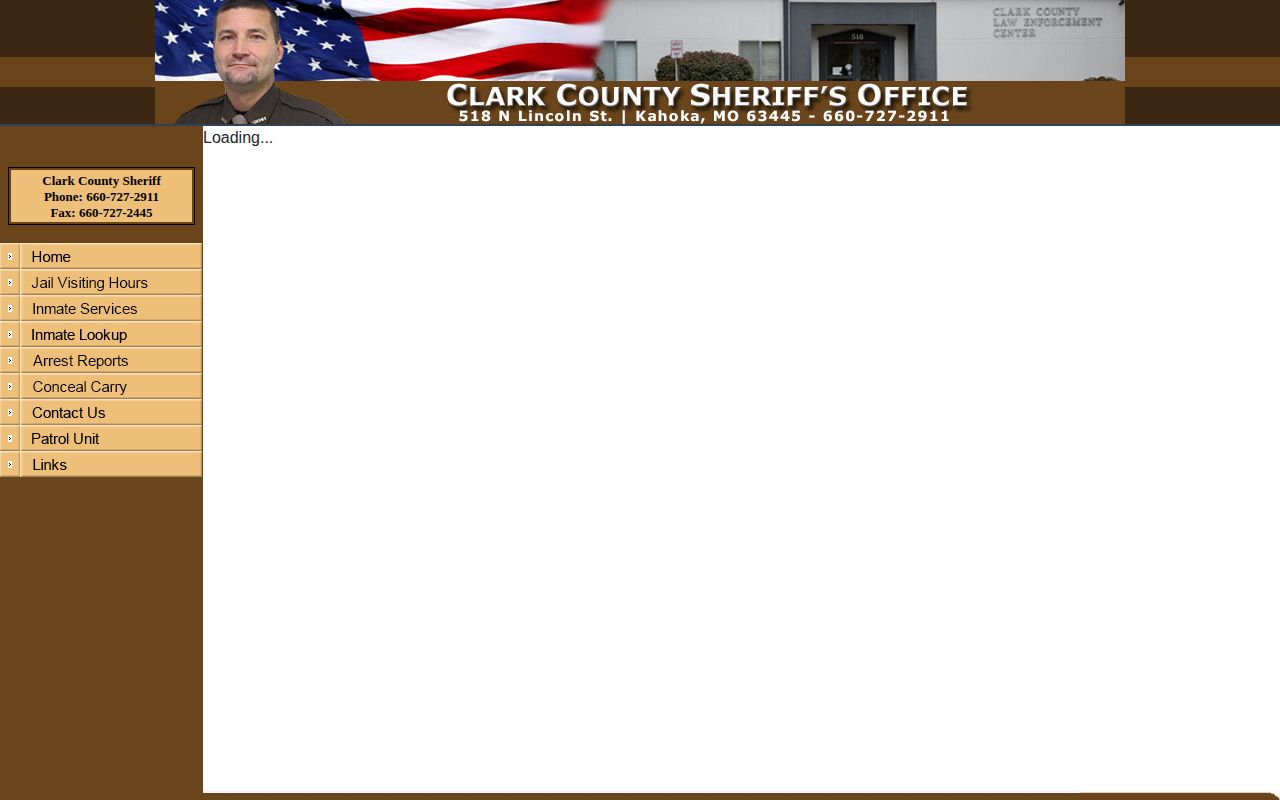
The change in page context comes from an older sheriff wrapper loading a modern cloud client. It still represents current listed custody, not a released-inmate archive.
Clark County Weekly Release Evidence
Clark County does not publish a verified rolling release feed for the last day or three days. The sheriff instead provides a current roster and week-bounded arrest-report PDFs. A report may contain name, age, residence, arrest date and time, arresting agency, an allegation or warrant basis, and sometimes an express release method. Booking number, release timestamp, photo, cell assignment, and bond amount were not shown as systematic report fields.
The Clark County sheriff report index shows current weekly PDFs and access to older-year reports.
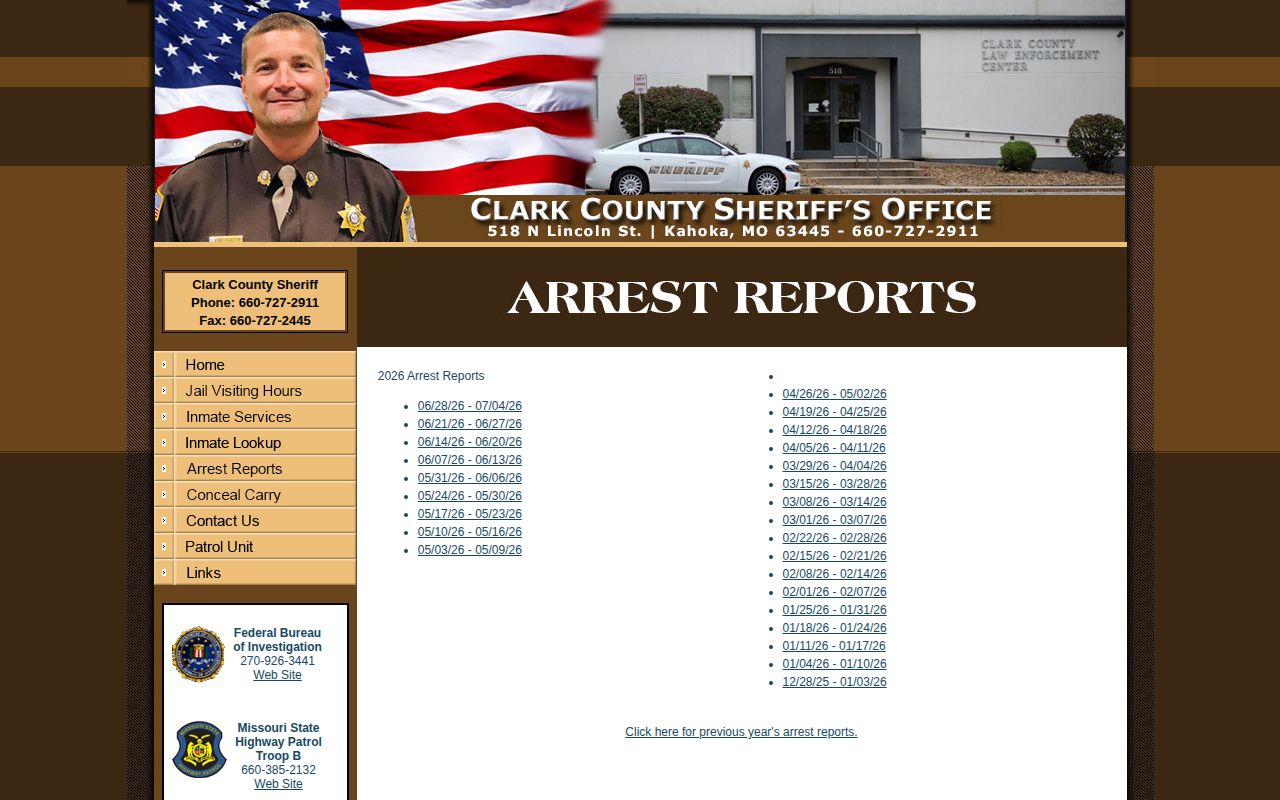
Check all reports that overlap the custody period because the Sunday-to-Saturday organization is not a release window or a guarantee of event completeness. Never create a release list by subtracting one roster snapshot from another.
Missouri Offender Release Search
The MODOC active Offender Search covers people in prison and people actively supervised on probation or parole. It accepts first and last name, accounts for aliases, and works best with an exact DOC number. A person released from prison to active parole or conditional release may still appear. Record the displayed status, assigned place or office, relevant dates, and the information timestamp.
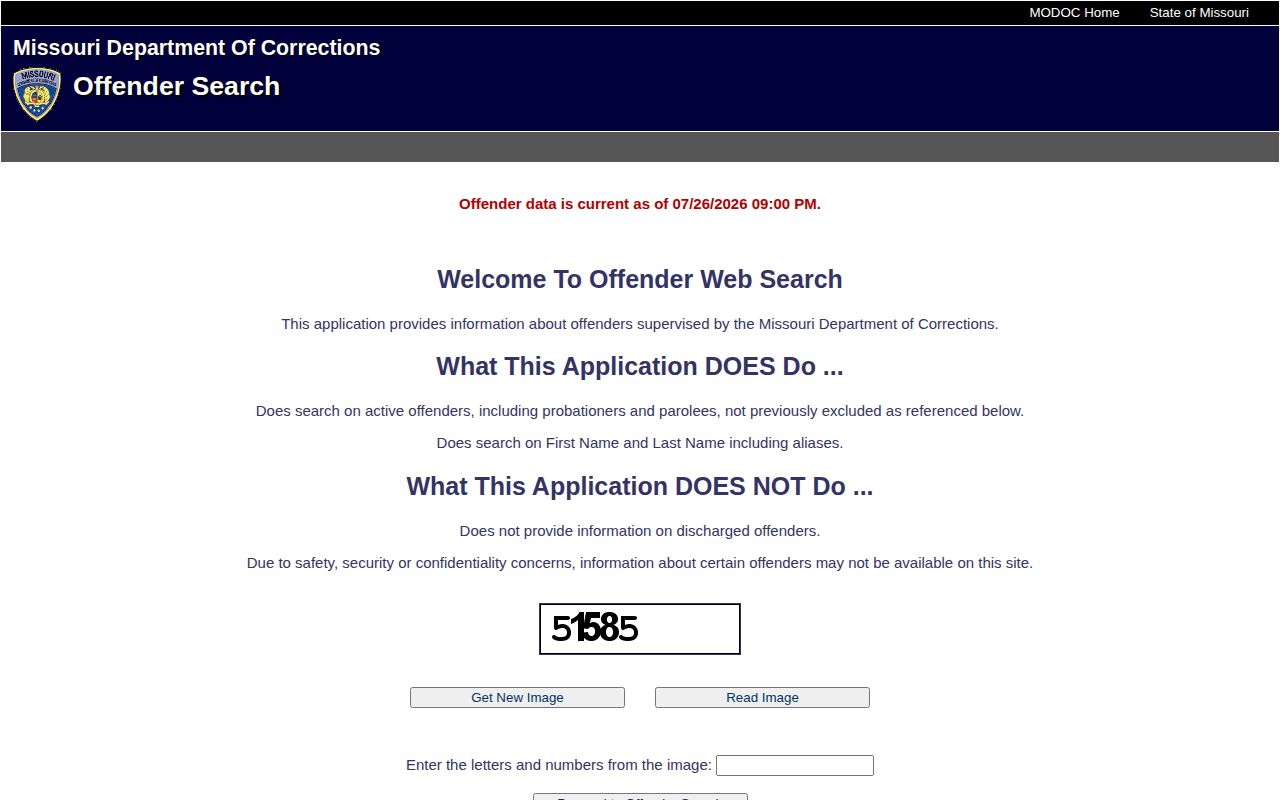
The portal expressly excludes discharged offenders. A no-result cannot prove release or final discharge, and some active data may also be withheld.
| Search field | How to use it | Main limit |
|---|---|---|
| DOC number | Use the exact identifier when known. | Only helps if the identifier matches the right person. |
| First and last name | Try known spelling and aliases. | Common names and spelling changes can mislead. |
| Status | Preserve the system's exact wording. | Active community supervision is not final discharge. |
| Assigned place | Use it to find the prison or field office. | Assignment may follow an approved plan, not conviction county. |
| Data date | Save it with the result. | Status may change after the refresh. |
Clark County Discharge Record Search
For a fully discharged state offender, move to the MODOC Sunshine Law database and record layouts. MODOC says the nightly file covers people who are or have been under department supervision, while warning that it may not reflect true current status.
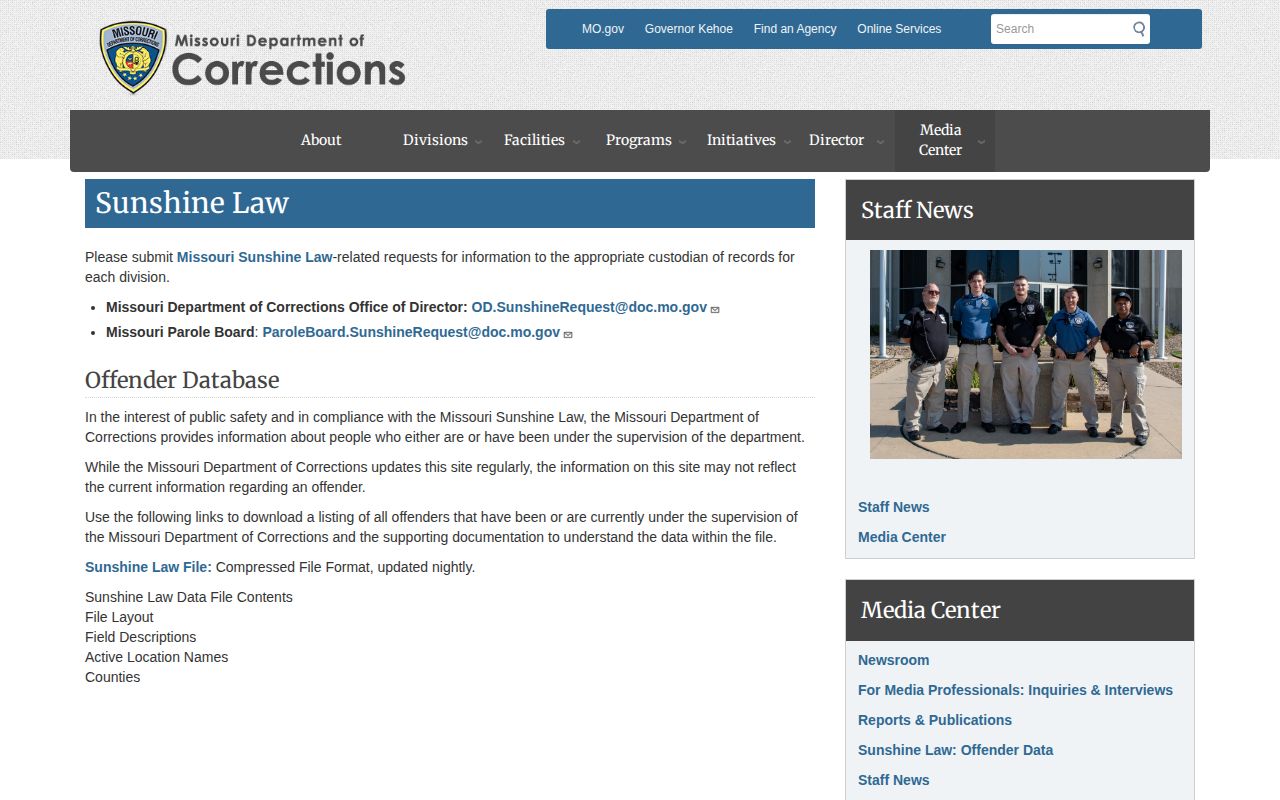
The download can contain several rows for one person because records are tied to charges. Match DOC ID, name, case, and county. The sentence-completed flag, `$SCF`, applies at the charge row. “Sentence-I Minimum Release Date,” `$PC`, is a calculated minimum on an active sentence, not the day someone left. `$PD` is the maximum release or expiration field. Direct MODOC verification remains stronger than an isolated row. Department record requests go to OD.SunshineRequest@doc.mo.gov, while Parole Board record requests go to ParoleBoard.SunshineRequest@doc.mo.gov.
Note: Life, indeterminate, and assessment sentinel values must be read from the official layout, not formatted as ordinary dates.
Clark County Release Supervision
Clark County has no separately listed local MODOC field office. The official district map places it in District 3, centered in Hannibal. The Hannibal Community Supervision Center can verify public facts about active probation, parole, conditional release, and earned discharge. A person can live in Clark County after leaving confinement while still remaining under MODOC legal authority.
Public supervision facts may include whether supervision is active, the officer and office, present offenses, judgment and sentence, conviction county, supervision term, conditions, parole or conditional-release date, and a Board release decision. Ask for those facts, not private case notes or protected personal details. MODOC Reentry Services also connects returning people with identification, transportation, care, and other supports.
Hannibal Community Supervision Center, District 32002 Warren Barret Drive
Hannibal, MO 63401
Phone: 573-248-2450
Weekdays: 7 a.m. to 5 p.m.; late by appointment
Clark County Release Notifications
Missouri now uses MOVANS for participating-agency custody searches and notifications. Clark County Sheriff's Office appears in the current provider data. Search by person and agency, compare identifiers, and preserve the exact status or event wording. Released, transferred, out of custody, and no match are not interchangeable.
A MOVANS alert is useful evidence of an agency-fed event, but it is not a certified release sheet or court disposition. Save the alert time and reporting facility, then ask that custodian to confirm the release type. State prison notification is a separate MODOC branch. The Missouri State Highway Patrol registry is also narrow: it covers registrable people, not everyone released from Clark County custody.
Clark County Court Release Bridge
Clark County belongs to the First Judicial Circuit. The Circuit Clerk gives a durable path from a vanished jail entry to the public order or disposition that authorized release. Search Case.net by litigant name or case number, constrain the court when possible, and compare the case number, charge, filing date, and non-sensitive identifiers. Useful docket entries can address bond, recognizance, warrant recall, probation, time served, dismissal, judgment, or sentence.
The Clark County Circuit Clerk page links court users to Case.net and gives the local access point.
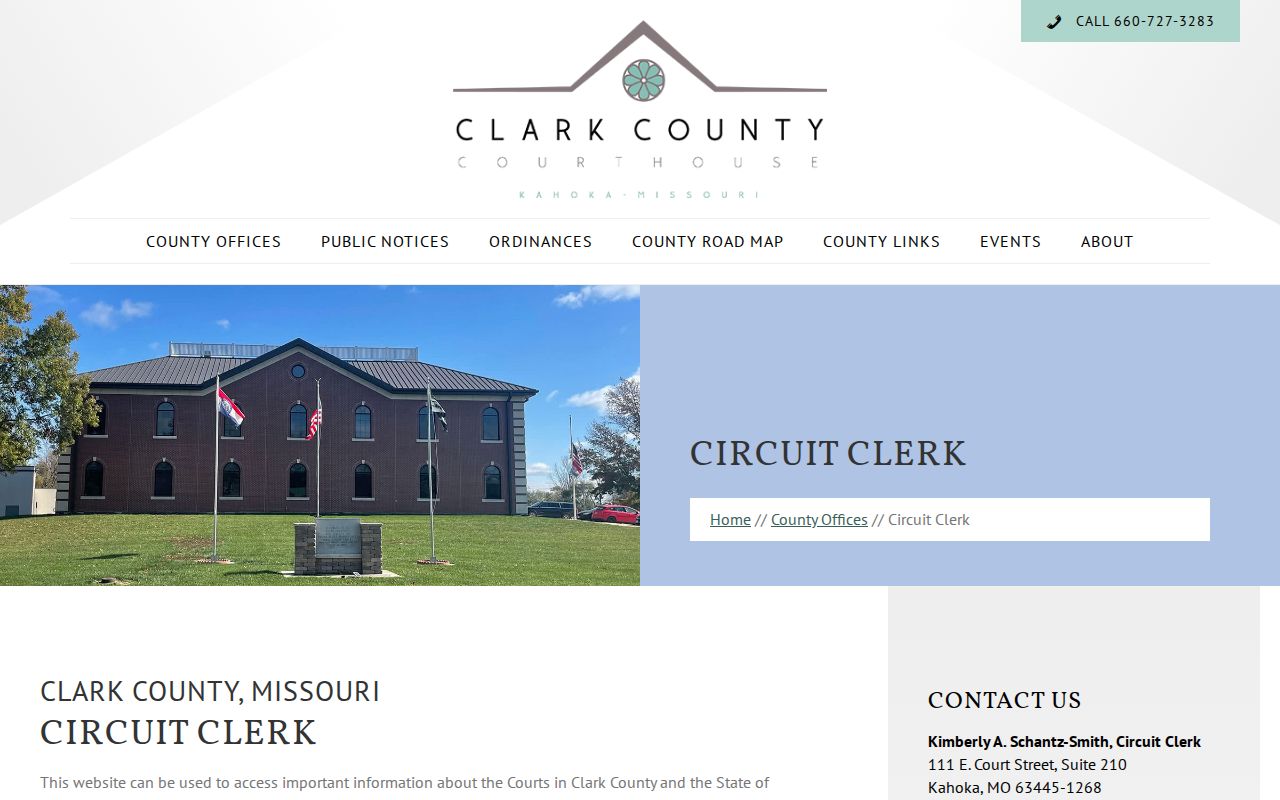
The clerk's public hours are 8 a.m. to noon and 1 to 4 p.m. on weekdays, with state holidays closed. Staff can assist with record access but cannot give legal advice. A docket proves the legal action, while the sheriff record is the better source for the physical exit time.
Clark County Federal Release Checks
The BOP Inmate Locator applies only to people who entered federal Bureau of Prisons custody. Search by federal identifier when known or by exact name with the listed matching fields. A past release date with no facility, or a location marked “RELEASED,” means the person is no longer in BOP custody. It does not rule out supervised release, another warrant, or immigration custody.
A person held locally on a federal matter may be managed by the U.S. Marshals Service before any BOP designation. There is no equivalent public real-time USMS detainee locator. Obtain the Clark County transfer disposition, identify the federal case, and follow the court or Marshals channel. If the receiver is ICE, use the official detainee locator and ERO contact route. ICE processing delay and limited post-release display make a no-result inconclusive.
Clark County Release Lookup Paths
Each public system answers a different question. Read its coverage before interpreting a match or a missing name.
| System | What it can show | What absence means |
|---|---|---|
| Clark County JailTracker | Current listed county custody | Release, transfer, movement, correction, or another change |
| Sheriff weekly reports | Some explicit local release methods | The event may be outside the week or not stated |
| Case.net | Public orders, bond actions, judgments, and dispositions | The record may be delayed, closed, sealed, or not matched |
| MODOC active search | Prison custody or active community supervision | Discharge is possible but not proved |
| MODOC nightly data | Historical and current charge-linked records | Search or identity limits require direct verification |
| BOP or ICE locator | Custody-specific federal information | Coverage and timing limits make no-result incomplete |
Getting Home After Clark Release
Clark County has a real but limited public transportation option. OATS Transit publishes Wednesday Kahoka and in-town service, advance reservations, and intercity routes. It is scheduled service, not an on-demand jail pickup. An unexpected release may not line up with the published day or reservation window.
Confirm the physical release time with the jail before planning a ride. Ask whether release is to the community or to another authority. Family transport or another confirmed ride may be needed when OATS does not fit. No official sheriff source reviewed promises a release door, transport arrangement, property process, or weekend schedule, so those details should be asked directly rather than assumed.
Clark County Release Facilities
Clark County custody can lead to local, state, supervised, federal, or immigration records. The facility map follows the authority that holds the person rather than assuming every missing jail name is a local release.
- Clark County Jail: local releases are confirmed through the sheriff record, weekly reports, and court case.
- Missouri Department of Corrections: Clark County sentences may be served at institutions elsewhere in Missouri.
- Hannibal Community Supervision Center: District 3 verifies active state supervision for Clark County.
- Federal Bureau of Prisons: the federal locator records BOP custody and release, not a county jail exit.
- ICE Detainee Locator: use it when the sheriff identifies immigration custody as the transfer path.
A county booking record remains with the sheriff even when the person goes elsewhere. Follow the receiving agency until the final custody change is clear, then compare it with the court authority.